
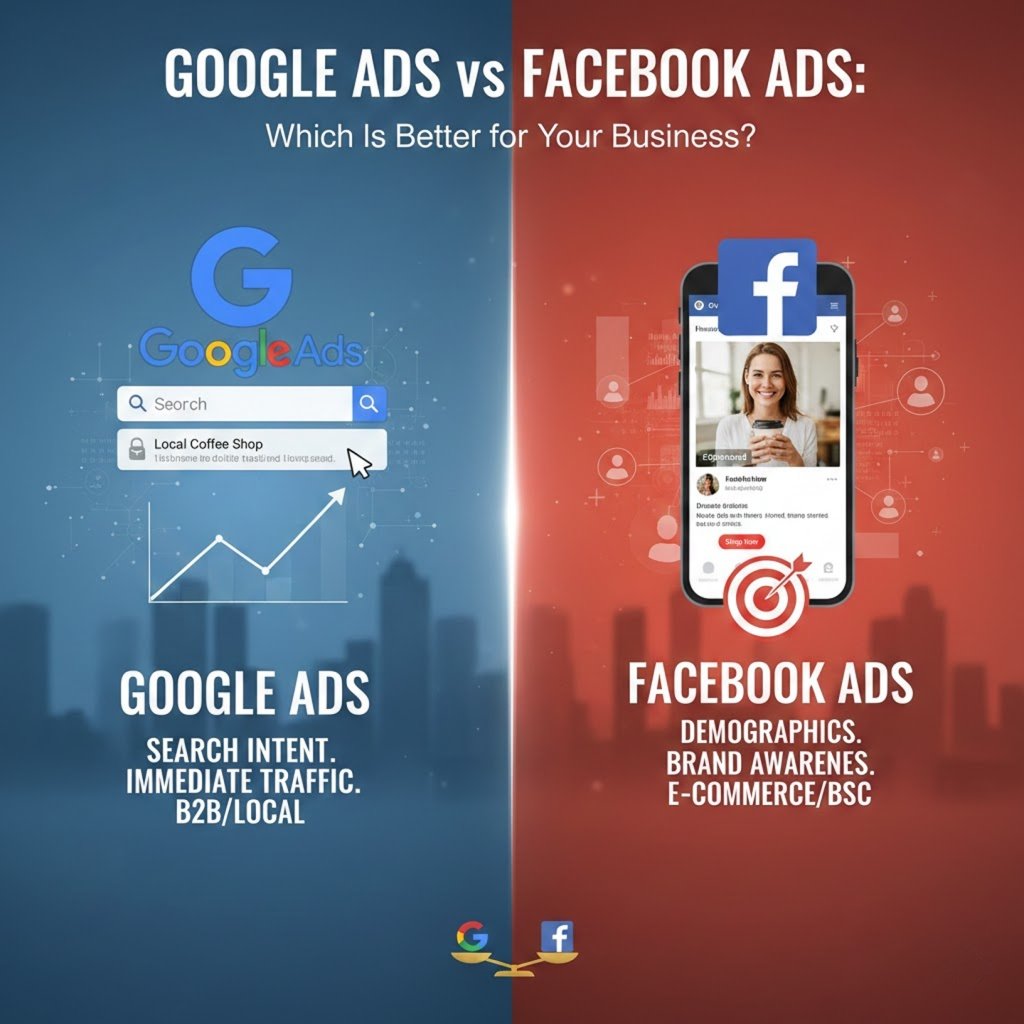
Digital marketing keeps evolving rapidly, and paid advertising has become one of the most essential parts of business growth. If you want more sales, leads, or brand awareness, advertising platforms will be the main players. Among all the options, the debate of Google ads vs Facebook ads is the most talked about by far.
Which platform brings more conversions, gives faster results, or is more cost-effective has been a question business owners and marketers have been asking all the time. Actually, both platforms have a lot of power but are designed to achieve different advertising goals.
We compare Google ads vs Facebook ads in this detailed guide by cost, performance, targeting, strategy, pros and cons, ROI, and expert recommendations so that you can determine which platform is the best fit for your business.
Understanding the Basics: What Are Google Ads?
Google Ads is an online advertising system where businesses using Google bid on keywords that they want to be associated with their product or service. So when a user makes a search using that keyword, the business is the one that appears in the results. Ads like these can be found on Google Search, YouTube, Display Network, Shopping, and also Gmail.
In distinction from social media ads, Google Ads is a platform that targets people who are already looking for a product or service, which makes it a platform with high intent. As an example, if a person searches Google with the term “AC repair near me,” “best digital marketer in Kerala,” or “buy shoes online,” the ads that are shown are the ones that have the closest match with the keywords.
This is the reason why in the debate of Google ads vs Facebook ads, Google is seen as a platform for demand-capturing that facilitates communication with users at the very moment when they are in need of something.
Why Google Ads Is Powerful
It is Google Ads, which can be seen as a very powerful tool because of its feature of directly targeting users who are the most probable buyers. If a person is looking for a solution and he/she makes a search, the chance of a visitor being turned into a customer is very high. Google provides measurable data, accurate targeting, and quick visibility to billions of searches that happen every day.
Besides, this kind of advertising is also beneficial for service-oriented industries such as real estate, healthcare, education, home repair, legal services, and digital marketing. With Google’s keyword-based targeting, businesses can decide who will be the exact people to see their ads, which is a great advantage when comparing Google Ads vs Facebook Ads.
Understanding the Basics: What Are Facebook Ads?
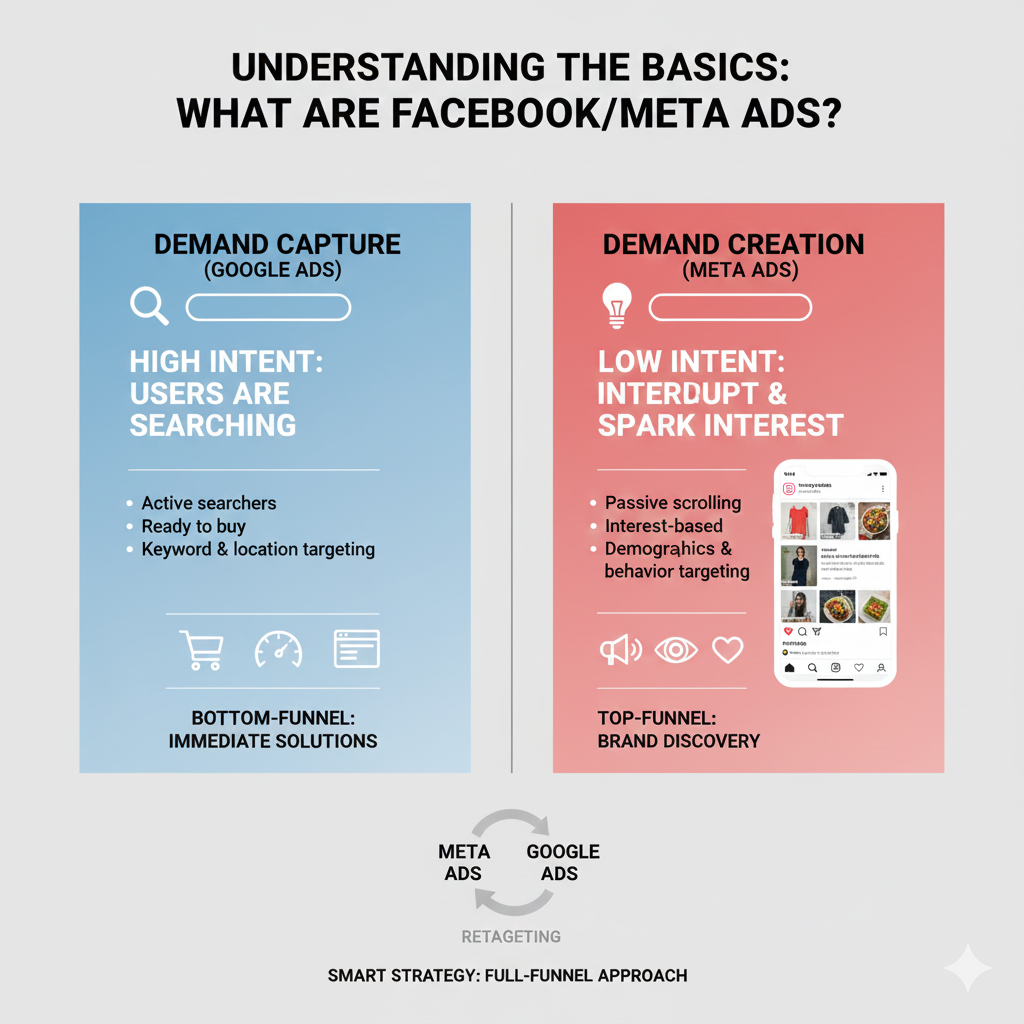
Facebook Ads is a social media marketing tool enabling businesses to advertise across Facebook, Instagram, Messenger, and Audience Network. Unlike Google, a Facebook user is not searching for something specific; they are simply scrolling for entertainment, social interaction, or content consumption. Facebook Ads target people based on their interests, lifestyle, demographics, and behaviors.
They also consider the user’s previous activity and engagement history. In the case of Google Ads vs Facebook Ads, Facebook works as a discovery platform where people come across new products that they might not be actively searching for but still find relevant. This is why, in the broader comparison of Google ads vs Facebook ads, Facebook is known for creating demand by introducing users to products they didn’t even realize they needed.
Why Facebook Ads Is Powerful
Facebook Ads are highly visual, affordable, and effective for brand awareness. They excel in creative storytelling through images, videos, reels, and carousels. Facebook offers advanced audience targeting, making it easy to reach people based on personality traits, hobbies, interests, and online behavior.
This makes Facebook ideal for product-based businesses such as fashion, jewelry, fitness, restaurants, photography, gadgets, and home décor brands. When evaluating Google Ads vs Facebook Ads, Facebook stands out for engagement, visibility, and emotional connection with audiences.
Google Ads vs Facebook Ads: The Core Difference
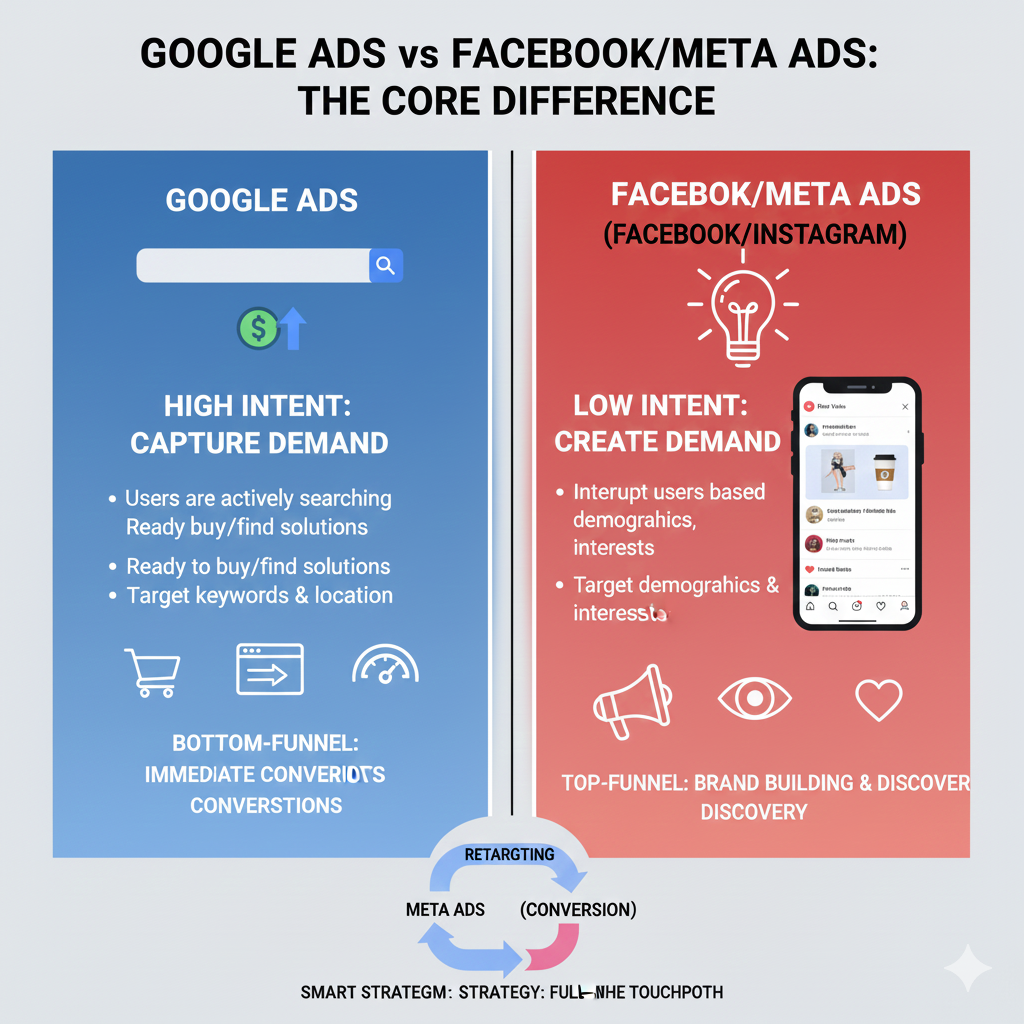
The primary difference between Google Ads and Facebook Ads is user intent. Google Ads target users with a very high level of intention — for example, searching “dentist near me” clearly shows that the user needs an immediate solution.
On the other hand, Facebook Ads target users who were not actively looking for anything but may become interested after seeing attractive visuals or persuasive content. Facebook creates demand, while Google fulfills that demand. This elemental difference is the key reason why many brands do not choose between the two but instead use both platforms simultaneously. In the comparison of Google ads vs Facebook ads, intent plays the biggest role, and when evaluating Google ads vs Facebook ads, it becomes clear that each platform supports different stages of the customer journey.
Google Ads vs Facebook Ads: Targeting Options
Targeting is at the center of every effective marketing campaign, and both platforms have different but equally strong ways of achieving it. Google Ads works mainly through keyword- and intent-based targeting, allowing businesses to show ads to users who are actively searching for their products or services at that exact moment. In addition, Google Ads can target demographics, device types, locations, in-market audiences, and can also be used for remarketing—an important point when comparing Google ads vs Facebook ads.
On the other hand, Facebook Ads reach the right audience based on interests, behaviors, lifestyle, age, gender, and custom/lookalike audiences. Facebook’s precise interest-based targeting makes it extremely effective for discovering new potential customers. In short, if your goal is intent-based targeting, Google Ads is the right choice, whereas for behavioral targeting, Facebook Ads performs better. This distinction becomes even clearer when evaluating Google ads vs Facebook ads for different marketing needs.
Google Ads vs Facebook Ads: Cost Comparison4
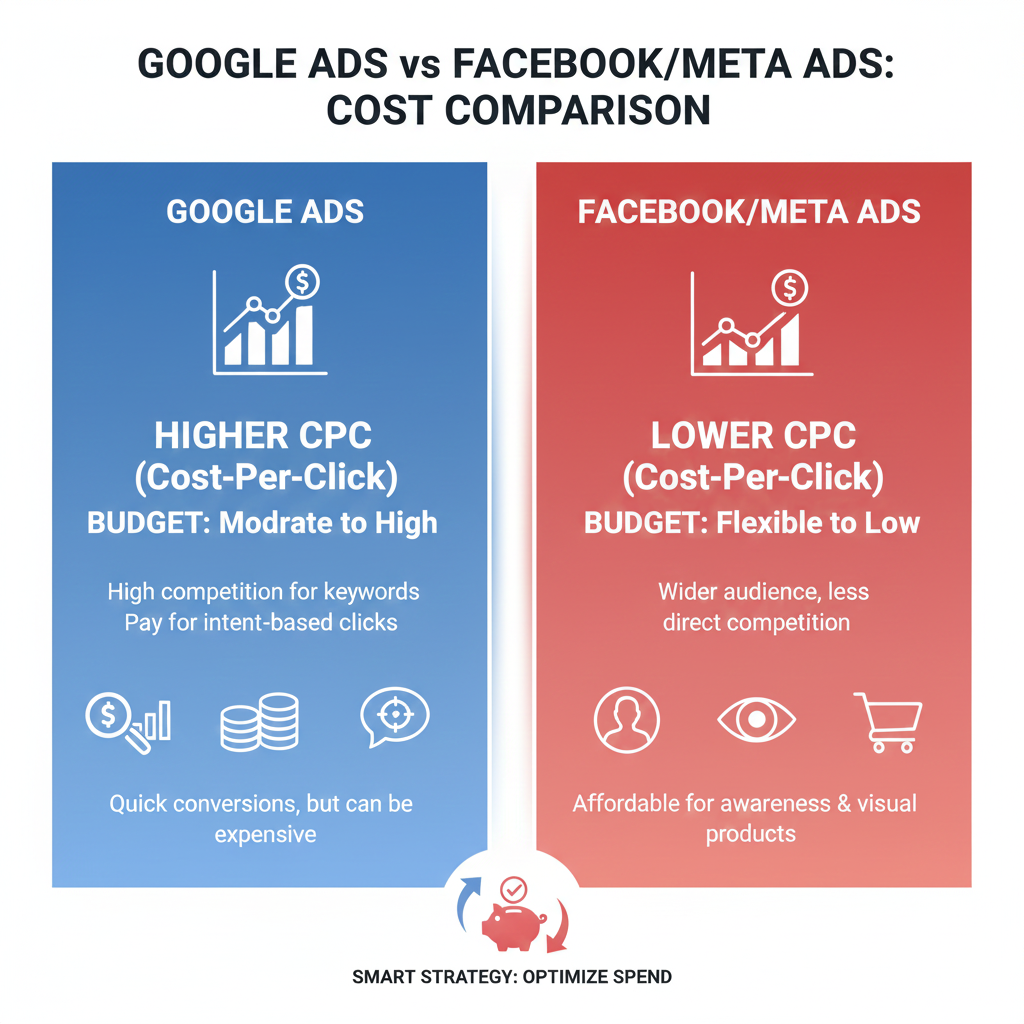
Cost is one of the main factors when selecting a platform.
Google Ads Cost
Google runs on a cost-per-click (CPC) system. Competitive industries like:
- Insurance
- Real estate
- Medical
- Digital marketing
often have higher CPC because many businesses bid on the same keywords.
But even though Google Ads can be expensive, the conversion rate is usually higher because of strong user intent.
Facebook Ads Cost
Facebook Ads are generally cheaper compared to Google.
You can reach thousands of people with even a small budget.
However, cheaper does not always mean better conversions.
Facebook users are not actively searching for your product.
Which Is Cheaper?
Between Google Ads vs Facebook Ads:
- Facebook is cheaper for engagement and reach
- Google is more cost-effective for conversions and leads
Cost varies depending on:
- Industry
- Target audience
- Competition
- Ad quality
Google Ads vs Facebook Ads: Ad Formats
Google Ads offers a wide range of ad formats, including Search Ads, Display Ads, YouTube video ads, Shopping ads, and App promotion ads. These formats work exceptionally well for performance-based marketing, making them especially suitable for service-oriented businesses. This is an important point when analyzing Google ads vs Facebook ads in terms of performance.
Facebook Ads, on the other hand, provide image ads, video ads, carousel ads, story ads, reel ads, and instant lead forms. These formats make Facebook a powerful visual-driven storytelling and branding platform.
Overall, when comparing Google Ads with Facebook Ads, it becomes clear that Google focuses more on search-driven performance, while Facebook emphasizes creative and visual engagement. This distinction matters even more when deciding how to use Google ads vs Facebook ads for different marketing objectives.
Google Ads vs Facebook Ads: Speed & ROI
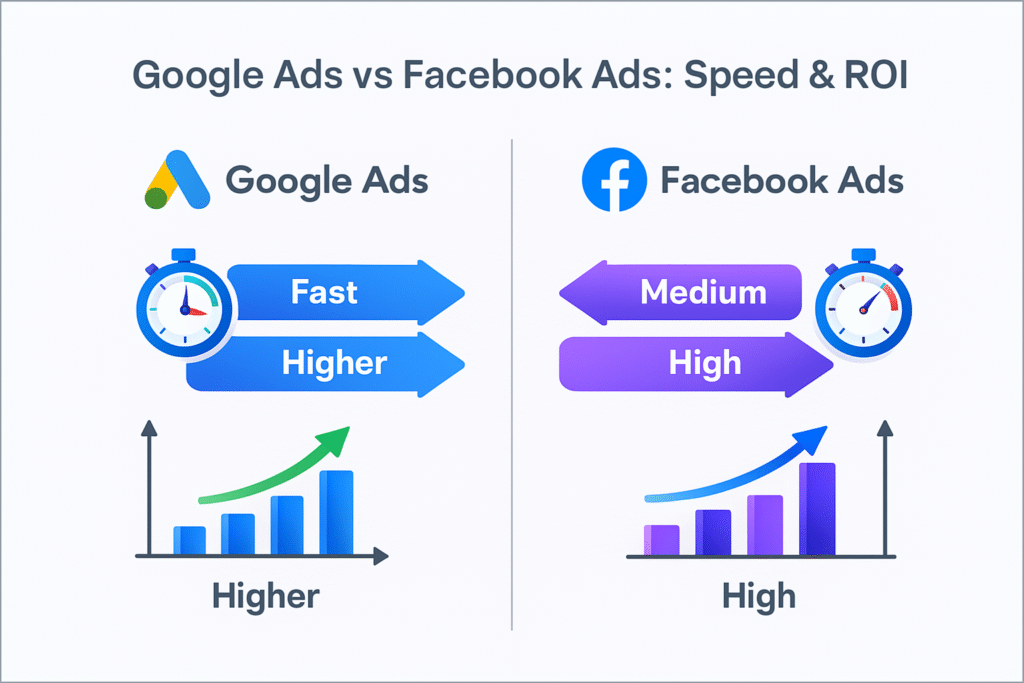
Different platforms vary in how long they take to deliver results. Google Ads is an excellent choice for quick outcomes because users already have a clear intention to buy or take action. This makes it ideal for companies that rely on leads, bookings, or appointments — a key advantage highlighted in discussions about Google ads vs Facebook ads.
Facebook Ads, however, focus more on awareness and engagement, which take time to build but become extremely powerful once matured. These campaigns help a brand become familiar and create emotional connections with the audience.
As a result, Google Ads works better for immediate lead generation, whereas Facebook Ads are more effective for product promotion, brand visibility, and long-term audience building. The highest ROI comes when businesses use both platforms in a coordinated strategy, especially when evaluating the strengths of Google ads vs Facebook ads in a combined marketing funnel.
Positive & Negative of Google Ads vs Social Media Ads
Below is a clean comparison of the advantages (positive) and disadvantages (negative) of both platforms, including your keyword Google Ads vs Facebook Ads.
Positive of Google Ads
1. High Intent Traffic
People search with purpose—making Google perfect for conversions.
2. Instant Results
Ads start generating clicks and leads immediately.
3. Accurate Keyword Targeting
You can target users searching for exactly what you offer.
4. Best for Lead Generation
Industries like real estate, medical, education, and legal perform well.
Negative of Google Ads
1. Expensive Keywords
Competitive industries pay high CPC fees.
2. Technical Setup Required
Wrong keyword selection wastes money fast.
3. Limited Visual Creativity
Google Ads depends more on text than visuals.
Positive Side of Social Media Ads (Facebook, Instagram)
1. Highly Visual & Engaging
Perfect for products, reels, videos, and creative ads.
2. Low Cost
You can reach thousands with a small budget.
3. Strong Interest-Based Targeting
Target people by lifestyle, behavior, age, gender, interests, and more.
4. Best for Brand Awareness
Social media ads are great for building trust and visibility.
Negative Side of Social Media Ads
1. Lower Buying Intent
Users are scrolling for entertainment—not searching to buy.
2. Creative-Dependent
Bad creatives = poor performance.
3. Algorithm Changes
Facebook’s frequent updates affect reach and performance.
Google Ads vs Facebook Ads: Best Option for Small Businesses
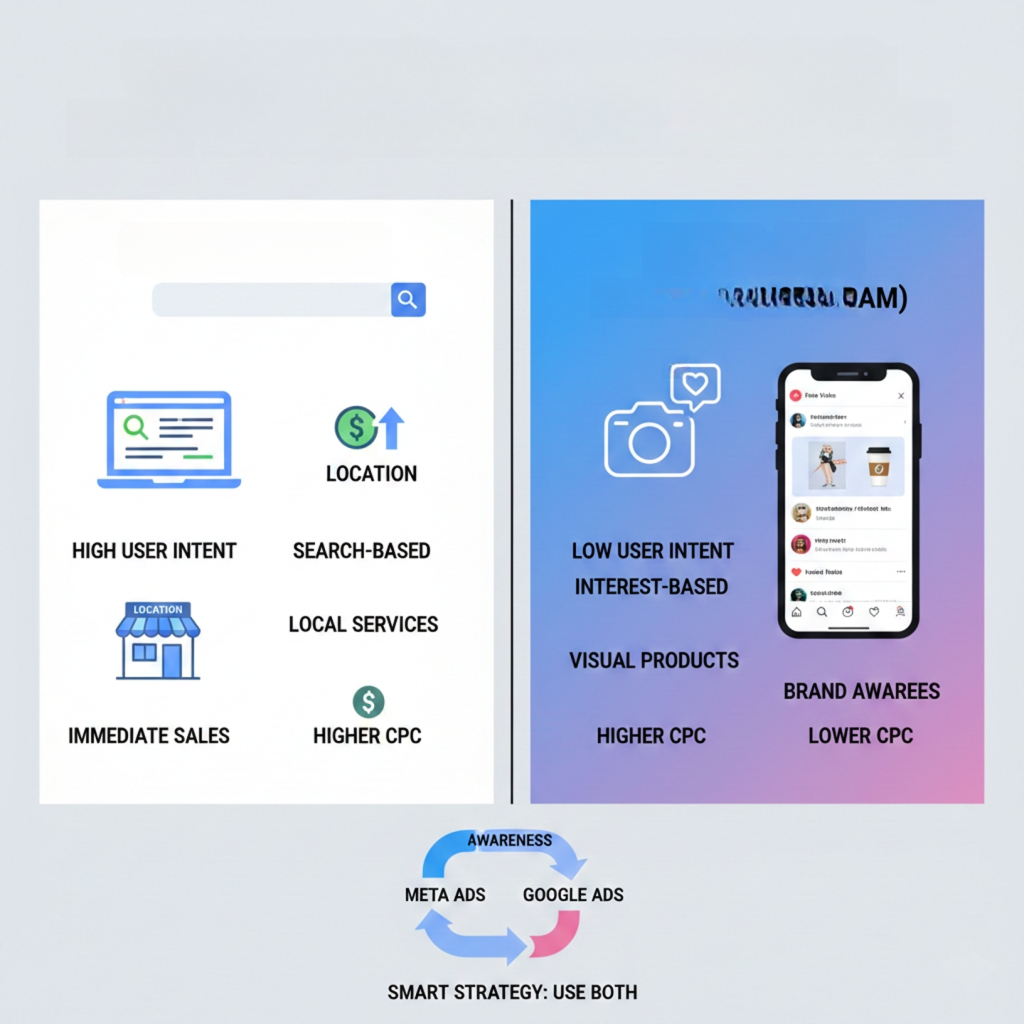
Small businesses usually work with limited budgets, which makes choosing the right advertising platform extremely important. Google Ads is most effective for service-based industries where customers rely heavily on search. Businesses such as hospitals, real estate agencies, coaching institutes, legal services, and repair services can generate strong results because people actively search for these solutions—a key point often highlighted in the Google ads vs Facebook ads discussion.
On the other hand, fashion stores, beauty parlors, restaurants, gyms, photography studios, and home décor brands are visually driven businesses that perform better on Facebook Ads. These platforms help showcase products creatively and attract users through visual appeal. Ultimately, the answer to the Google ads vs Facebook ads debate depends on business type, customer behavior, and overall marketing goals
Google Ads vs Facebook Ads: Retargeting Power
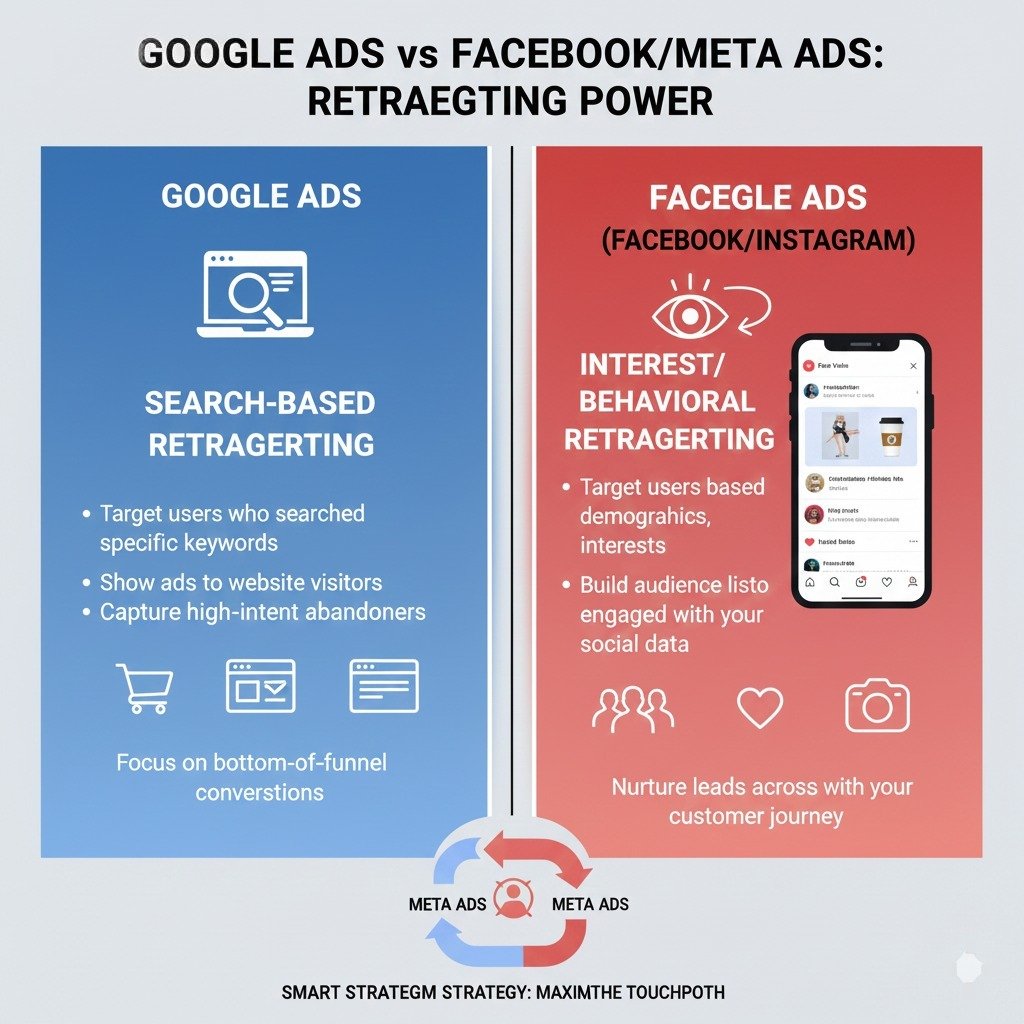
Retargeting is one of the most effective ways to place brand ads in front of users who have already interacted with the business. Google allows retargeting through ads on YouTube, the Display Network, Search, and Shopping. On the other hand, Facebook offers retargeting through website visitors, Instagram engagement, page interactions, video watchers, and story engagers. Individually, these two platforms are very efficient in retargeting, and combining them can significantly increase the conversion rate. It is a case of Google ads vs Facebook ads, where they complement rather than compete, especially when businesses aim for maximum conversions. In many strategies, understanding Google ads vs Facebook ads helps marketers decide how to integrate both platforms for stronger retargeting performance.
Google Ads vs Facebook Ads: Expert Recommendation
Essentially, a majority of digital marketing experts would argue that the most potent strategy should not be to decide between Google Ads and Facebook Ads but to use both at the same time. In other words, Facebook is a tool for generating interest and awareness while Google is for obtaining leads with a high likelihood of buying. Retargeting on both channels significantly improves conversion rates and lowers advertising costs. The leading brands, which have the highest return on investment, are those that employ a combination of the two to prove that the real power is in the integration of both platforms.
Google Ads vs Facebook Ads: Summary Table
| Factor | Google Ads | Facebook Ads |
|---|---|---|
| User Intent | High | Low–medium |
| Cost | Higher CPC | Lower CPC |
| Best For | Leads, conversions | Awareness, engagement |
| Ad Format | Search, display, video | Image, video, reels |
| Audience Type | Searching for solutions | Discovering content |
| Speed | Fast | Medium |
| ROI | High for services | High for products |
Google Ads vs Facebook Ads Which Should You Choose?
First of all, it seems pretty clear after the assessment of cost, targeting, intent, formats, and ROI that the decision is Google Ads in a case of high-intent leads, quick conversions, and measurable results. Facebook Ads would be a nice option if your objective was brand awareness, creative storytelling, or affordable reach.
The best decision will be to employ both platforms concurrently if that is your ultimate goal, i.e., to get the highest return on investment. The ideal customer journey is where Facebook generates awareness, Google grabs intent, and retargeting finalizes the conversion.
Such a multistep strategy leads to the strongest impact in the current digital marketing environment.